







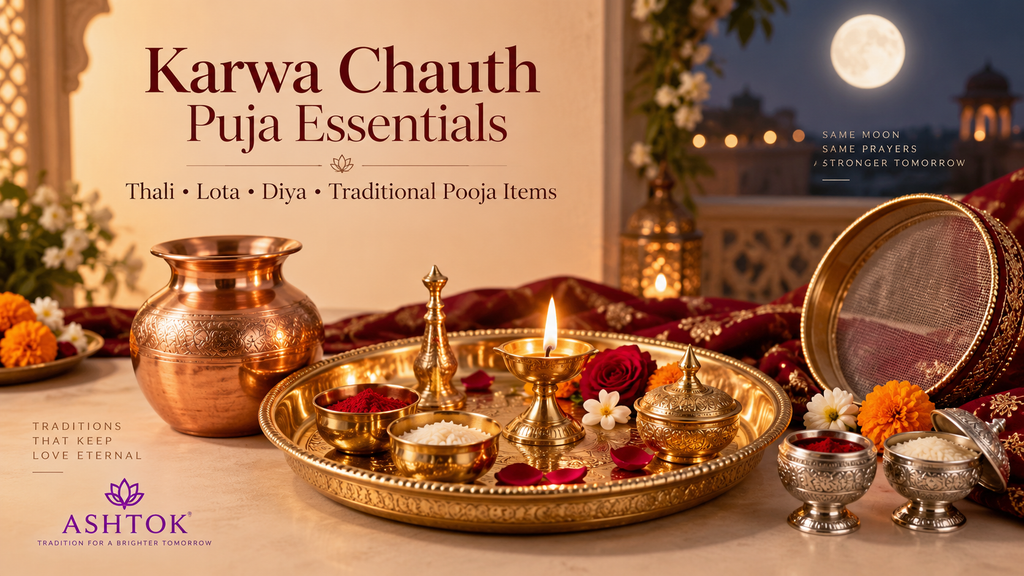
Preparing the right Karwa Chauth puja items in advance can make the evening rituals much easier to organise. From the Karwa Chauth thali and diya to the lota, channi, kumkum, rice and flowers, each family may follow slightly different customs, but a few traditional pooja essentials appear in most preparations.
If you are observing Karwa Chauth for the first time, refreshing an older pooja set or simply want a more organised festive arrangement, this guide explains the main items to keep ready, how to choose suitable materials and how to arrange your thali before the evening puja.
Traditional metalware such as brass, copper and German silver can also be reused for Diwali, daily pooja and other family ceremonies, making it practical beyond one festival.
Complete Karwa Chauth Puja Items Checklist
Family traditions differ, so treat this as a practical checklist rather than a fixed religious rule.
Main Puja Vessels
Keep the following ready:
- Karwa or ritual water vessel
- Karwa Chauth thali
- Lota or kalash for water
- Diya
- Channi or sieve
- Small katoris or pooja bowls
- Spoon where required
Traditional Puja Samagri
Depending on your family custom, the thali may also contain:
- Roli or kumkum
- Haldi
- Akshat or uncooked rice
- Sindoor
- Chandan
- Cotton wick
- Ghee or oil for the diya
- Flowers
- Incense or dhoop
- Camphor
- Sweets or prasad
- Fruits
- Water
Items for Moonrise
Many families keep these together before going outside for the moon-viewing ritual:
- Channi
- Lit diya
- Water-filled lota
- Karwa
- Puja thali
- Sweets or food used when completing the fast
Keeping everything arranged beforehand reduces the need to search for items at the last minute.
Karwa Chauth Thali: The Centre of the Puja Setup
The Karwa Chauth thali acts as the main base for organising the evening pooja items.
A practical thali should be wide enough to hold the diya and small containers without feeling overcrowded.
What Goes in a Karwa Chauth Thali?
A typical arrangement may include:
- Diya
- Kumkum or roli
- Akshat
- Sindoor
- Flowers
- Sweets
- Small pooja bowls
- Water vessel placed beside or near the thali
- Channi kept ready for moonrise
Regional and family traditions may add other items.
Brass Pooja Thali for Karwa Chauth
A brass pooja thali works particularly well for traditional festive setups because of its warm golden appearance and reusability.
When choosing one, look at:
- Diameter
- Rim depth
- Available space for bowls
- Weight
- Decorative detailing
- Ease of cleaning
ASHTOK's Brass collection currently includes brass pooja plates and other traditional pooja articles that can be incorporated into a Karwa Chauth setup. Ashtok
A larger thali is helpful if you want the diya, flowers and several small containers on the same plate. A compact plate may be sufficient for a simpler family ritual.
Copper Lota for Puja and Water Offering
A copper lota for puja is another traditional metal item that can be useful in a Karwa Chauth setup.
Depending on family custom, water may be kept in a lota or another ritual vessel for use during the evening ceremony and moonrise.
ASHTOK's Copper collection currently includes pure copper pooja plates, copper lotas and kalash-style ritual vessels. Ashtok
Karwa vs Lota: Are They the Same?
Not always.
The karwa traditionally refers to the vessel specifically associated with the festival. Depending on family tradition, it may be made from clay or metal.
A lota is a rounded water vessel commonly used in Hindu pooja and ritual water offerings.
Some households use separate vessels, while others may follow a different family practice.
Choosing a Copper Lota
Look for:
- Comfortable size
- Stable base
- Smooth rim
- Easy grip
- Suitable capacity
- A shape that is easy to pour from
If you also use copper serveware at home, ASHTOK's Copper Tableware collection can be explored separately for traditional dining and serving pieces.
Diya for Karwa Chauth Puja
The diya is one of the most visually important Karwa Chauth pooja items.
A diya may be kept on the pooja thali during the evening ritual and is also commonly present during moon-viewing preparations.
Brass Diya
A brass diya is suitable when you want something that can be reused across festivals.
After Karwa Chauth, the same diya can be brought out for:
- Diwali
- Dhanteras
- Navratri
- Dussehra
- Daily pooja
- Housewarming ceremonies
Choose a diya with a stable base, particularly if it will be placed on a thali with other items.
What to Check Before Lighting
Make sure:
- The diya sits level
- There is sufficient room around the flame
- The wick is positioned securely
- Decorative fabric, flowers and loose packaging remain away from the flame
Safety matters more than creating an elaborate arrangement.
Channi for the Moon-Viewing Ritual
The channi or sieve is one of the items most closely associated with Karwa Chauth.
It is traditionally kept ready for the moonrise part of the celebration.
Because designs and ritual practices vary between families, use the type of channi followed in your household rather than selecting one only for appearance.
If you are preparing your puja items for the first time, keep the channi beside the thali rather than trying to fit every item onto one plate.
Kumkum, Roli, Sindoor & Akshat Bowls
Small bowls make a Karwa Chauth thali much easier to organise.
Instead of keeping loose powders directly on the plate, use small katoris for items such as:
- Kumkum
- Roli
- Haldi
- Chandan
- Akshat
- Sindoor
This keeps the thali neat and helps prevent colours from mixing.
German Silver Pooja Bowls for a Decorative Setup
German silver works well when you want smaller pooja accessories with a bright silver-toned appearance.
ASHTOK's German Silver collection currently includes products such as Gandham Ginnis, kumkum bowls, haldi-kumkum holders, puja bowls, trays and Kamakshi-style deepams. Ashtok
German Silver Kumkum Bowl
A compact bowl can be used for:
- Kumkum
- Chandan
- Sindoor
- Haldi
- Other small dry pooja materials
Haldi-Kumkum Holder
A double-bowl style holder can help keep two pooja materials together while maintaining a tidy arrangement.
German Silver Tray
A small tray can be used as a secondary pooja plate or for arranging smaller ritual items depending on your family custom.
Use German silver mainly for decorative pooja accessories where its appearance suits the rest of your thali.
Which Material Is Best for Karwa Chauth Pooja Items?
There is no single material that must be used for every item.
Choose according to family tradition, intended use and how often you want to reuse the product.
| Material | Good for | Appearance | Main advantage |
|---|---|---|---|
| Brass | Thali, diya, bowls, pooja accessories | Warm golden | Traditional and reusable |
| Copper | Lota, kalash, puja plate | Warm reddish-metal tone | Well suited to ritual vessels |
| German Silver | Kumkum bowls, trays, decorative pooja accessories | Bright silver-toned | Decorative and gift-friendly |
| Kansa / Bronze | Selected bowls and ritual tableware | Deep traditional metallic tone | Heritage appearance |
| Stainless Steel | Practical thali, katoris and utility vessels | Clean silver finish | Easy everyday maintenance |
For a coordinated setup, you do not necessarily need every piece to match.
A brass thali with a copper lota and German silver kumkum bowls can still create an attractive traditional arrangement.
How to Arrange a Karwa Chauth Puja Thali
A simple arrangement is usually more practical than overcrowding the plate.
Step 1: Start with the Diya
Place the diya near the centre or toward the front of the thali, leaving safe space around the flame.
Step 2: Add the Small Bowls
Arrange bowls for:
- Kumkum
- Rice
- Haldi
- Sindoor
Keep them together so they remain easy to reach.
Step 3: Add Flowers and Prasad
Leave a clean section for flowers, sweets or other offerings followed in your family.
Step 4: Keep the Lota Beside the Thali
A water-filled vessel can become heavy and unstable if placed on a crowded plate.
Keeping it beside the thali is often more practical.
Step 5: Keep the Channi Ready
Place the channi nearby so it can be taken along easily when it is time for the moon-viewing ritual.
Karwa Chauth Puja Items for First-Time Observers
If this is your first Karwa Chauth, you do not need to buy an elaborate set immediately.
Start with the core items followed by your family:
- Thali
- Karwa
- Lota
- Diya
- Channi
- Small pooja bowls
- Kumkum or roli
- Rice
- Flowers
- Sweets or prasad
Then add decorative pieces only if you genuinely want them.
It is also worth asking a parent, mother-in-law or elder family member whether your family follows any specific regional custom.
That is more reliable than assuming every online checklist applies exactly to your household.
Karwa Chauth Puja Setup by Budget
Simple Essential Setup
For a practical budget-conscious setup, prioritise:
- One thali
- One diya
- One lota
- Small bowls
- Channi
Use your existing home pooja accessories where possible.
Traditional Coordinated Setup
For a more traditional look, consider:
- Brass pooja thali
- Brass diya
- Copper lota
- Matching brass or German silver bowls
This gives you a coordinated arrangement while keeping each material suited to a particular use.
Decorative Festive Setup
If presentation is important, add:
- Decorative German silver kumkum holders
- Ornamental diya
- Larger brass thali
- Separate pooja tray
- Flower arrangement
Do not let decoration reduce the practical space needed for the actual ritual items.
Karwa Chauth Puja Essentials That Can Be Reused
One of the biggest advantages of buying metal pooja products is that they can remain useful after Karwa Chauth.
A brass diya can be used for Diwali.
A copper lota can remain part of your regular pooja setup.
A German silver kumkum bowl can be used during wedding ceremonies, housewarming functions and festival pooja.
A brass pooja thali can return for many family rituals.
This makes reusable traditional puja items a more practical purchase than highly occasion-specific decoration.
Karwa Chauth Pooja Items as Gifts
Traditional pooja articles can also be considered when preparing a first Karwa Chauth gift or a ceremonial gift for a daughter or daughter-in-law.
Suitable items might include:
- Brass diya
- Brass pooja thali
- Copper lota
- German silver kumkum holder
- Small pooja bowls
If gifting, prioritise a useful piece over creating an oversized set filled with items the recipient may already own.
Buying Guide: What to Check Before Ordering Puja Items Online
Before ordering any Karwa Chauth pooja product, check the specifications carefully.
Material
Confirm whether the product is brass, copper, German silver, stainless steel or another metal.
Do not judge material only from colour.
Dimensions
Check the actual diameter and height.
A product may look large in photographs but be designed as a compact pooja accessory.
Number of Pieces
For sets, confirm exactly what is included.
Do not assume a photographed diya, lota or bowl is included unless the listing says so.
Intended Use
Check whether the product is intended for:
- Pooja
- Serving
- Decoration
- Food contact
- Gifting
Follow the individual product's usage guidance.
Maintenance
Traditional metals require different care routines.
Choose according to how much maintenance you are comfortable with.
Care Tips for Brass, Copper & German Silver Puja Items
Brass
Wipe dry after cleaning and use an appropriate brass-cleaning method when required.
Copper
Dry thoroughly after washing. Copper naturally changes appearance over time, so follow product-specific cleaning instructions.
German Silver
Use a soft cloth and avoid harsh abrasives that may scratch decorative surfaces.
General Storage
Before storing festive pooja pieces:
- Make sure they are fully dry
- Wrap delicate decorative items separately
- Keep them away from moisture
- Store diyas only after removing leftover oil and wick residue
Good storage makes it easier to bring the same products out for the next festival.
Shop Traditional Karwa Chauth Puja Items at ASHTOK
Preparing your Karwa Chauth puja items early gives you time to focus on the celebration instead of searching for a thali, lota or diya at the last minute.
Start with the essentials followed in your family, then choose reusable metalware according to your preference.
A brass pooja thali creates a traditional base, a copper lota for puja works naturally with ritual water arrangements, and German silver bowls can help organise smaller pooja materials neatly.
Explore ASHTOK's Brass collection, Copper collection, Copper Tableware and German Silver collection when choosing traditional pieces that can continue to be used for Karwa Chauth, Diwali and other family ceremonies.
Frequently Asked Questions
What are the main Karwa Chauth puja items?
Common items include a puja thali, karwa, lota, diya, channi, kumkum or roli, rice, sindoor, flowers, sweets and water. Exact requirements vary by family tradition.
What should be kept in a Karwa Chauth thali?
A thali commonly holds the diya, roli or kumkum, rice, sindoor, flowers, sweets and small pooja bowls. The lota and channi can be kept alongside it.
Is a lota needed for Karwa Chauth puja?
Many families use a lota or water vessel during the evening and moon-viewing rituals. Follow the custom practised in your family.
Which metal is best for a Karwa Chauth pooja thali?
Brass is a popular traditional choice, while stainless steel is practical and easy to maintain. Choose according to family custom, budget and reuse.
Can I use a copper lota for Karwa Chauth?
Yes, a copper lota can be used as a traditional water vessel where it matches your family ritual practice.
What is the difference between a karwa and a lota?
A karwa is the festival-associated ritual pot, often clay or metal. A lota is a rounded water vessel commonly used for pooja and water offerings.
What puja items should I buy for my first Karwa Chauth?
Start with a thali, karwa, lota, diya, channi and small bowls, then add kumkum, rice, flowers, sweets and other items followed in your family tradition.
How should I arrange my Karwa Chauth thali?
Place the diya securely, arrange small bowls for kumkum and rice around it, add flowers and prasad, and keep the water vessel and channi nearby for easy use.